How I used AI to watch a political debate more carefully
I gave Claude the transcript of a debate on California's Prop 40 billionaire tax, then used it to organize the arguments, fact-check the claims, and build a break-even simulator. Here is the method, and what it showed me.
The setup
Two economists debated California’s Prop 40 at USC: a one-time 5% tax on billionaires who lived in California on January 1, 2026. Emmanuel Saez (UC Berkeley) argued Yes. My friend Matthew E. Kahn (USC) argued No.
Debates go fast. Claims fly by, numbers get thrown around, and by the end you mostly remember who sounded more convincing. I wanted a better way to judge it, so I tried this:
- I downloaded the YouTube transcript of the full debate.
- I gave it to Claude and asked it to help me think through it.
The method
Here’s what I asked Claude to do, in order:
- Map the arguments. List each side’s main claims, with the timestamp where each was made. That turns a 90-minute conversation into something you can scan in two minutes.
- Fact-check the claims. For each claim, find the public research behind it, and flag anything that’s an estimate or a prediction rather than a fact.
- Find where they actually disagree. Most of a debate is people talking past each other. The useful question is which few assumptions drive the different conclusions.
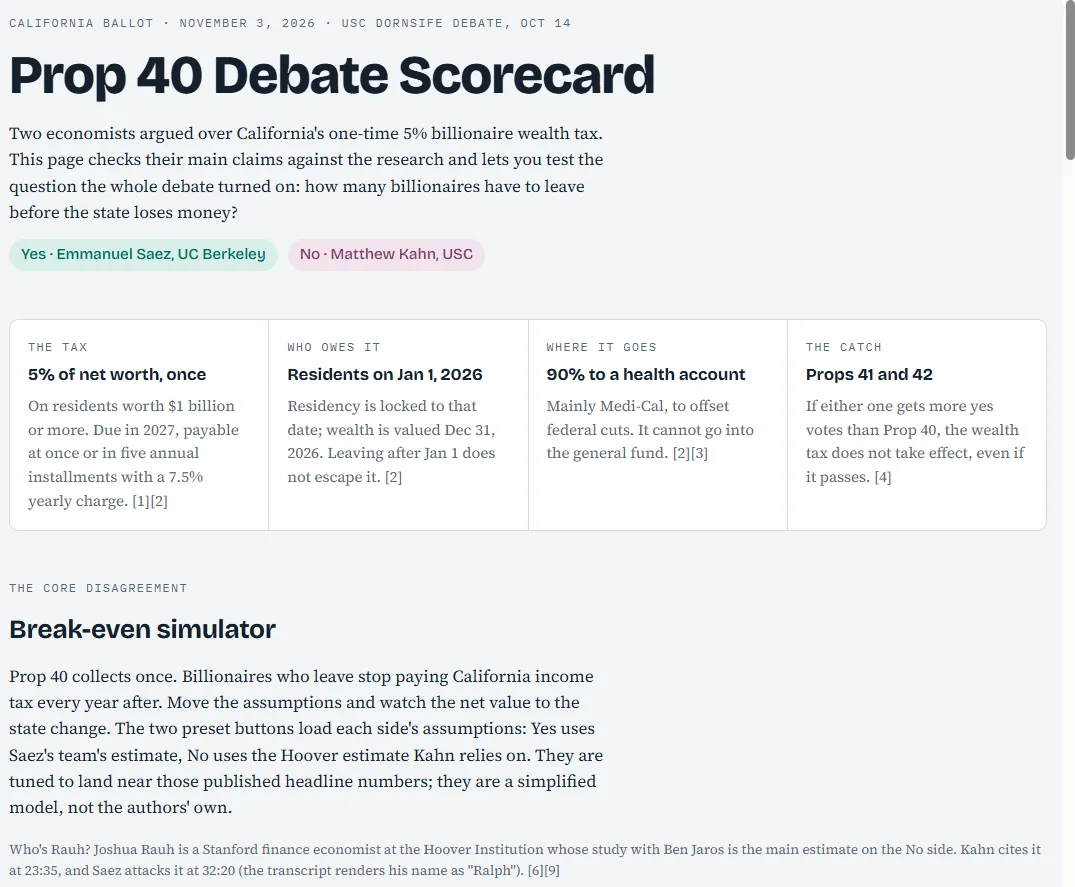
- Build something to test it. Claude helped me build a “Debate Scorecard” and a “Break-even simulator”: you adjust assumptions, like how many billionaires leave, and watch whether the state comes out ahead or behind.
One important note: the simulator is a simplified model calibrated to each side’s published estimates, not their actual models. It’s a thinking tool, not a forecast.
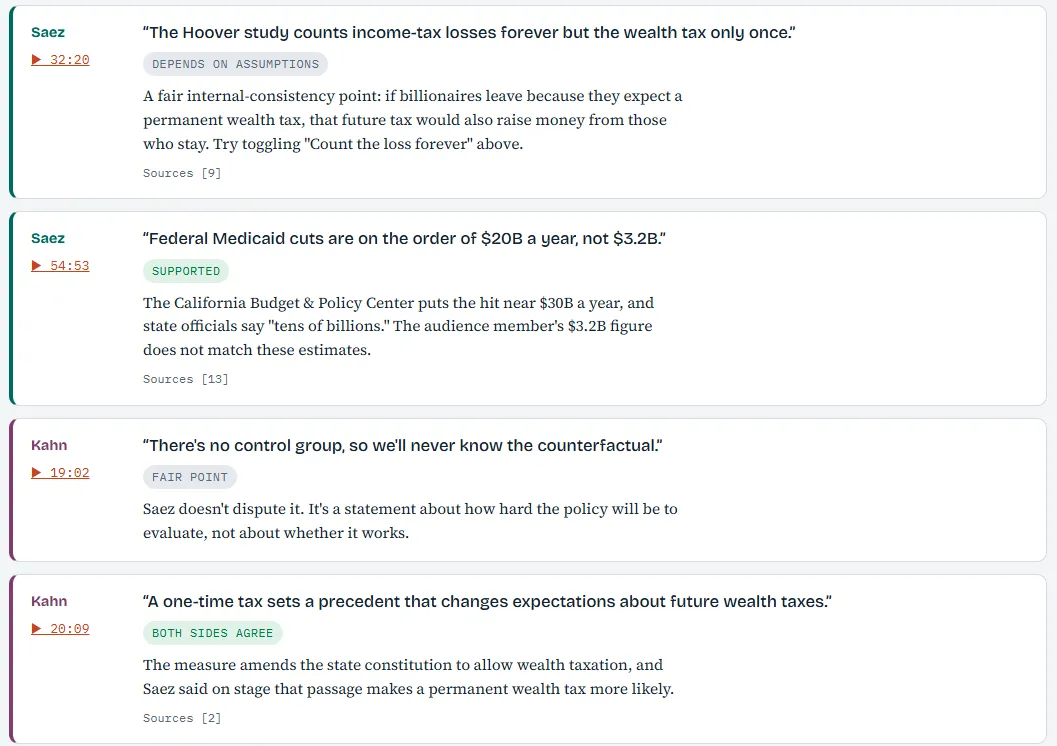
Each claim gets a timestamp, a verdict, and its sources. The verdicts rate the specific claim as stated on stage, not either side’s overall argument:
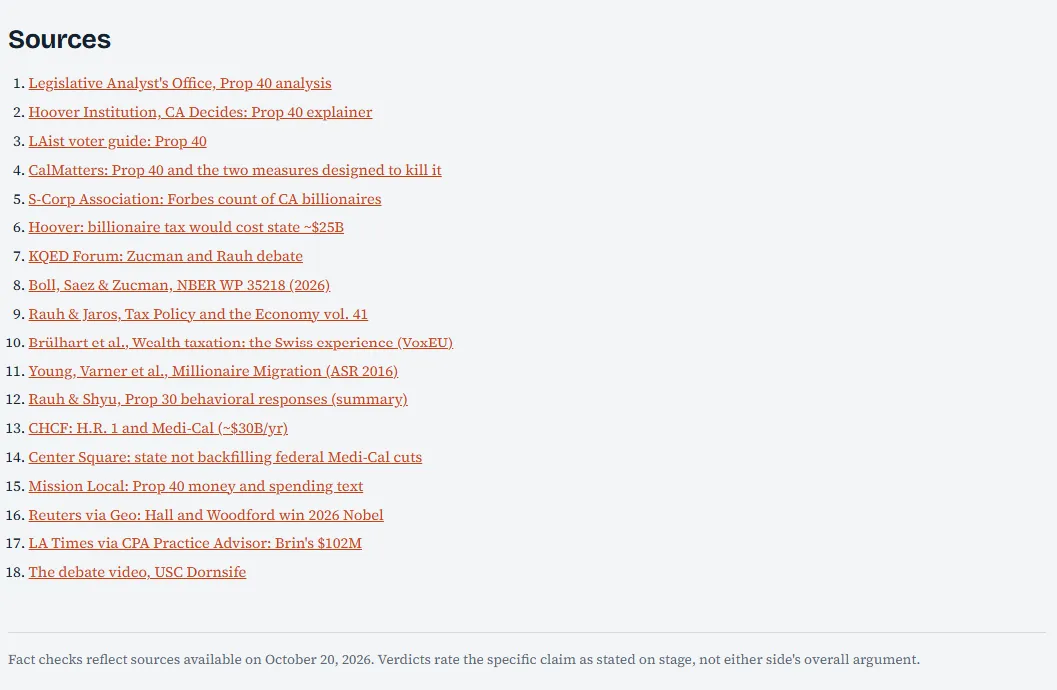
Every fact check links back to public sources, from the Legislative Analyst’s Office to the research papers each side relies on:
What it showed me
Yes side (Saez): billionaire wealth has exploded, the income tax barely reaches it, and Medi-Cal is about to lose roughly $20B a year in federal funding.
No side (Kahn): a “one-time” tax sets a precedent, top talent is more mobile than we assume, philanthropy could shrink, and the state should rebudget rather than backfill.
The point that stuck with me most was Matt’s poker analogy. Billionaires have every incentive to exaggerate and say they’re moving to Texas. The tax calls that bluff. And nobody knows where the tipping point is before a run on California talent.
Then the simulator made the disagreement concrete. The two sides’ estimates split on two questions, about equally:
- How much actually gets collected (roughly $100B vs. $30B)
- How much income tax walks out the door afterward
Load the Yes side’s numbers and the state nets about +$96B. Billionaire wealth would have to leave at a rate of 68% before the state loses money:
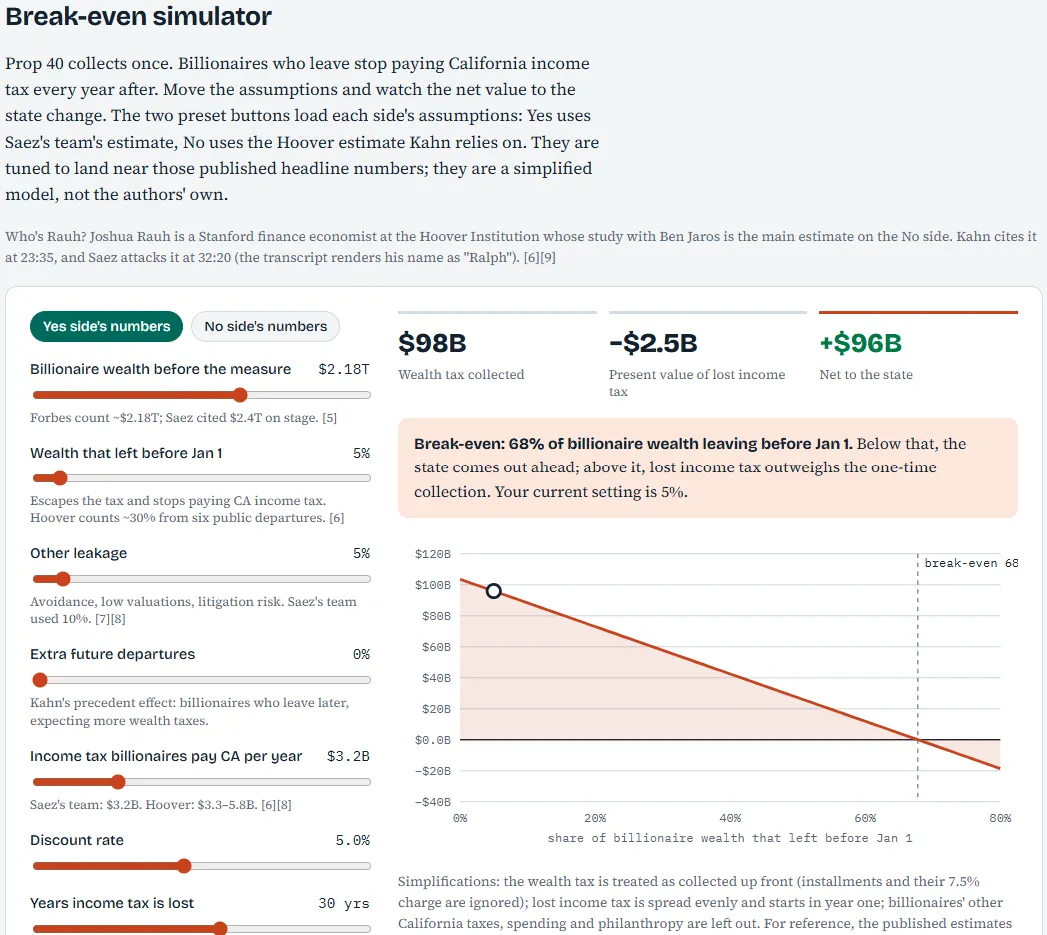
Load the No side’s numbers and it flips to about -$37B, with break-even at just 11%:
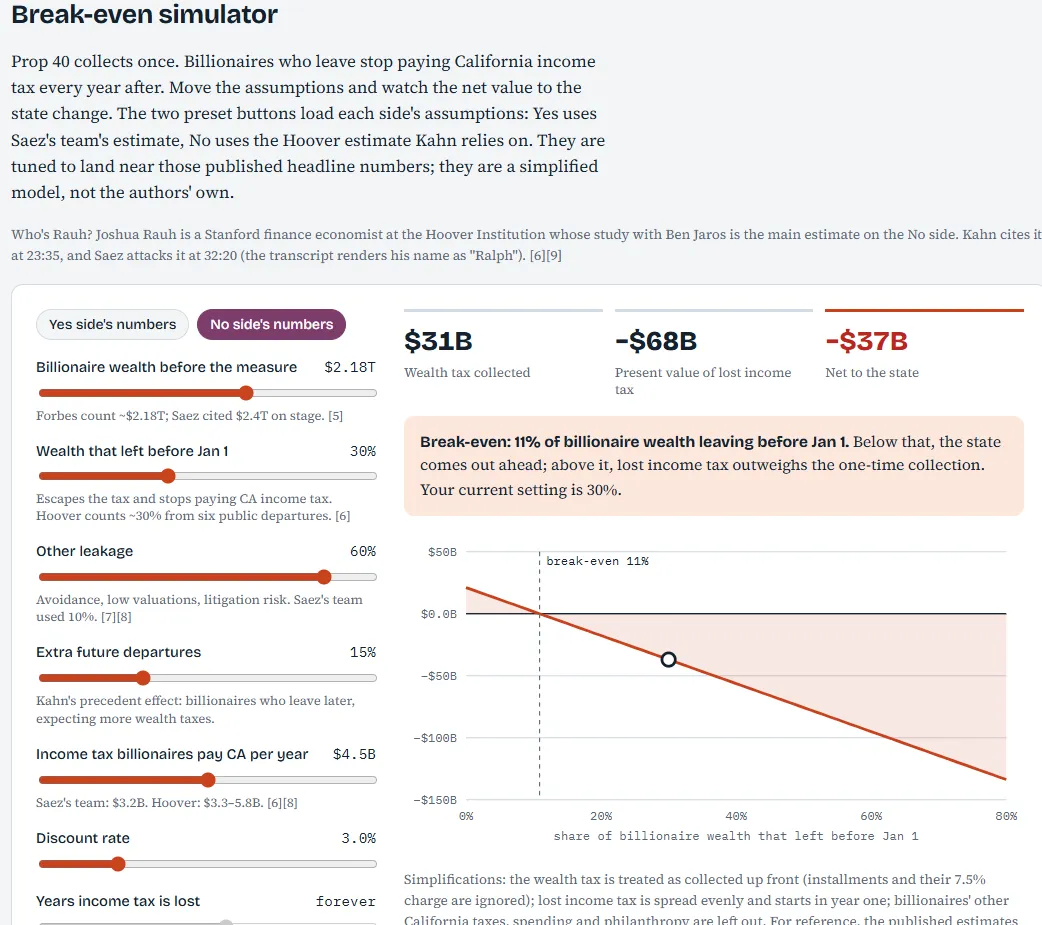
Neither question is settled. Once you see that, the debate stops being “who’s right” and becomes “which assumption do you believe, and why?”
Where I land
I’d be a Yes, but Matt’s case is the best I’ve heard on the No side. My read:
- This hand is already dealt. Residency locked on January 1. A few folded early. Everyone else is in.
- The next hand is the real test. Matt worries about a run on talent. My bet is on something quieter: money routing around California.
Why this matters beyond Prop 40
You can use this method on any debate, earnings call, or town hall:
- Get the transcript instead of relying on memory.
- Map the claims with timestamps so you can go back to the source.
- Separate facts from estimates.
- Find the one or two assumptions the whole disagreement hinges on.
AI didn’t tell me how to vote. It helped me understand why two smart people disagree, and that’s a much better place to decide from.